Why search can fix DLL issues
- Installers leave traces: backups like
.DL_,.DL~, orfilename(1).dllmay still exist. - Config tools rename files: variants/suffixes often sit beside the app.
- Faster fix: restoring a verified local copy can beat a full reinstall.
Prepare your search
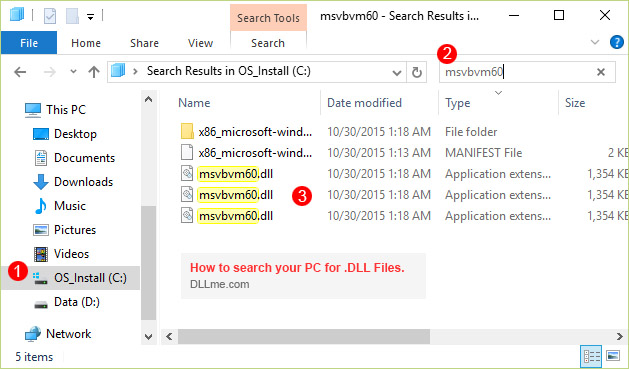
- Open File Explorer.
- Choose This PC or select a drive for a full-machine search.
- Enable View → Hidden items to include hidden folders and files.
Enter your search query
Start a search by replacing the filename with the DLL name (without .dll):
name:filename*
Replace filename with the DLL's base name (without .dll), e.g., vcruntime140.
Tip: Sort results by Date modified to find the newest copy first.
Review results & restore safely
- For filename(1).dll or filename.dl~: copy out, then rename to
filename.dll. - For .DL_ files: expand them first (next step).
Expand compressed backups (.DL_)
Windows (expand.exe)
expand "C:\Path\filename.dl_" "C:\Path\filename.dll"
7-Zip (GUI)
Right-click the .DL_ → 7-Zip → Extract here.
Install & test the DLL
- Prefer the app-folder method: see How to Install .DLL Files.
- If the vendor requires registration, use RegSvr32.
Notes: WinSxS & hidden items
- WinSxS: Don’t copy files out of
C:\Windows\WinSxS. Use SFC to restore protected system files. - 32-bit vs 64-bit: Match your app; try the other if errors persist.
- Hidden folders: Keep Hidden items on to include
%AppData%/ProgramData.
Search infographic